Showing posts with label lessons learned. Show all posts

Sunday, September 6, 2009

What's zone 9?


Photo Source

One of the things I never paid much attention to was our our first/last frost dates are. I figured, hey we live in SoCal so I can plant what I want, when I want. Right? WRONG! After all the denial, I finally looked it up.

Zone 9 = Average dates Last Frost = 30 Jan / 28 Feb
Average dates First Frost = 30 Nov / 30 Dec

--USDA Plant Hardiness Zone Maps

Basically, this is saying I can probably garden well into November and even push it. We have some BIG BIG plans for the garden next year so it seems like we'll be doing all the renovations in Jan 2010 so we can start the garden in March. What renovations? We are finally going to finish off the retaining walls and put in a new sitting wall on the hill. We are also going to hook up a better irrigation system and build a new trellis for the grapevines and raspberries.

Back the the idea of planting and harvesting. I think I'm pretty much done planting for the rest of the year. What is out there is out there.

Thursday, August 27, 2009

Container Gardening...

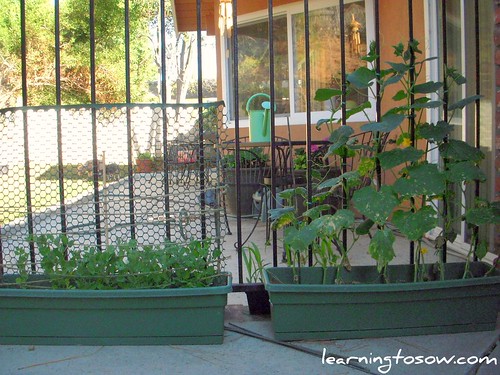
When I moved all our herbs, I didn't really have a good place to put them so I threw them in a container. I've never done much container gardening before so this was new to me.


Basil, chives, sage, oregano, and something else

I also wanted to grow some more cucumbers and peas. I had these two long containers that had annuals in them. We chucked all of them and planted more seeds. I've shown photos in the past but here are they today! Cucumbers are already blossoming!!!


So far, so good! Can't wait to see how high they will grow! At the moment we are using twist ties we got from the produce section at the market. seems to be working like a charm! The vines are already 3 times longer than when I had them laying on the ground.

Wednesday, August 12, 2009

Learning to grow a new life...

When we first started out, we didn't have any idea of what we were were doing. To be honest, we didn't even know if what we planted would even grow. We set out and built a wall on our hill to use up some of the wasted space and made a garden. It started out pretty simple and then grew to take over most of the hill we had. So far we've harvested more the 54 lbs of food and realized we had a bit of a knack for it. Not to shabby for our first year in production.

Now, I'm not saying we know what we're doing now, if fact we don't. Every day I'm wondering if I should do this, or do that. I'm constantly looking up plant diseases and tend to fall asleep with my organic gardening book on my lap. But with all the said and done, I'm amazed at what a garden can do.

The garden not only taught us alot about micro farming but also about our lifestyle. We became more eco-friendly and conscious of what we ate. We exchanged the rice for squash and left the canned tomatoes at the grocery since we had a bush spitting out tomatoes left and right. Snack time meant going to the snow peas and pulling off a few to nibble on before dinner. It's been quite a journey these last few months and can't wait to see what errors we made and what surprises we stumble upon.

Thursday, August 6, 2009

Things you learn along the way...

Okay, so like I said before, we're learning as we go! Before last spring, I had no clue that we needed to "feed" the plants. I never knew that marigolds are nature's way to keep pests away. I never knew egg shells are the answer. I just figured you dig, throw seeds in and just water. For some, it is that easy, for other things it's a little more difficult.

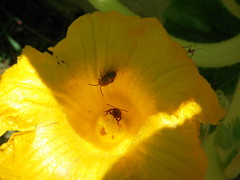
One thing I realized is how important bees are. I first read how they are needed for corn. With no bees, there's no corn. Now, I realized how extremely important they are to pumpkins. Well, I just found this fantastic article on how to do the pollination yourself if you find yourself deficient in bees. I usually see a few bees chilling out in our pumpkin blossoms. Now I understand what they are doing when they go from one blossom to another. I had no clue there was a male blossom and a female blossom! So tonight I am going to go inspect our "little" pumpkin vine and see how many females we have on there. I know we have lots of males and those males are good for making tempura with! Yum!!!

Off to see what else is worth finding in the garden!

Monday, June 8, 2009

Things I learned today

Why do I plant marigolds in my vegetable garden?

Marigolds are easy to grow and they help keep the away aphids. “The relationship between plants and insects is known as ‘companion planting.’ it’s by far the safest, natural way to garden organically.”

SHERIDAN NURSERIES GARDEN TIP gives you tips on Plants That Naturally Repel Insects:There are many beneficial herbs that keep insects away.

Ø Peppermint repels ants, white cabbage moths, aphids, and flea beetles.

Ø Garlic discourages aphids, fleas, Japanese beetles, and spider mites.

Ø Perennial Chives repel aphids and spider mites.

o Chives are often planted among roses to keep aphids away and to resist the disease, Blackspot.

Ø Basil drives away flies and mosquitoes.

Ø Borage deters that monster of vegetable garden insects, the tomato hornworm.

Ø Rosemary and Sage repel cabbage moths, bean beetles, and carrot flies.

Ø Annual Marigolds can be used anywhere to deter Mexican bean beetles, squash bugs, thrips, tomato hornworms, and whiteflies. They are also known to repel harmful root knot nematodes (soil dwelling microscopic white worms) that attack tomatoes, potatoes, roses, and strawberries. The root of the Marigold produces a chemical that kills nematodes as they enter the soil. If a whole area is infested, at the end of the season, turn the Marigolds under so the roots will decay in the soil. You can safely plant there again the following spring.

Ø Nasturtium is another annual, in this case a trailing vine, that keeps away Colorado potato bugs, squash bugs, and whiteflies.

Ø The perennial, Artemisia or Wormwood, deters slugs that are so devastating to foliage.

Ø Radishes can be planted to discourage cucumber beetles, squash bugs, and stink bugs.

Attracting Good Insects To Your Garden:

Plant certain vegetables, herbs, or flowers in your garden to attract predatory insects that will feed on the harmful, undesirable ones.

to read more, click here!